
Undergraduate Management Courses in India
Last Updated on July 26, 2026 by Vinod Saini
Quick answer: India offers six main undergraduate management courses — BBA, BBA (Hons), BMS, Integrated BBA+MBA (IPM), specialised BBAs, and management-focused B.Com — most lasting 3–4 years after Class 12. Students from science, commerce, and arts streams can apply. Admission runs through entrance exams such as IPMAT, NPAT, SET, and CUET-UG. Fresher salaries range from ₹3–4 LPA at average colleges to a ₹29.57 LPA average for IIM Indore’s five-year IPM batch of 2025.
A BBA graduate from a mid-tier private college starts at roughly ₹3–4 lakh a year. A student who cracked IPMAT in Class 12 and joined IIM Indore’s five-year integrated programme averaged ₹29.57 lakh in 2025. Same subject. Same starting point. Wildly different outcomes.
That gap explains why choosing among undergraduate management courses in India confuses so many students and parents. Every brochure promises an “industry-ready curriculum,” and the course names — BBA, BMS, BBM, IPM — sound interchangeable even though they lead to very different places.
By the end of this post, you’ll know which management courses after 12th actually exist, how they differ on eligibility, duration, fees, and salaries, which entrance exams matter for the upcoming admission cycle, and a four-question framework to pick the right path — whether you’re a student, a parent, or a counsellor advising one.
Why Picking a Management Course After 12th Is Harder Than It Looks
Ten years ago, “business management courses after 12th” meant one thing: BBA. Today you’ll find BBA (Hons), BMS, BBM, integrated BBA+MBA, and BBAs in everything from aviation to sports management — often at the same college, at different fees.
Three things make this decision genuinely difficult:
- Names hide more than they reveal. A BMS at Delhi University is more selective than most BBAs, while a “BBA (Hons)” at a lesser-known college may just be a standard BBA stretched under the NEP 2020 four-year format.
- Placement claims rarely come with methodology. “Highest package ₹18 LPA” tells you nothing about the median student’s offer — and the median is what will likely happen to you.
- The stakes moved up. With IIMs now admitting students straight after Class 12, the best management route no longer starts after graduation. It starts in Class 11.
The Real Decision: Three Paths, Not Thirty Course Names
Strip away the branding and every UG management course falls into one of three paths:
- Generalist degrees (BBA, BMS, BBM) — broad business foundation, keep every door open
- Specialised degrees (BBA in Digital Marketing, Aviation, Sports, or Business Analytics) — earlier focus, narrower exits
- Integrated degrees (five-year BBA+MBA or IPM) — one decision, one exam, UG and PG locked in together
Once you see it this way, the question stops being “which of thirty courses?” and becomes “which of three paths matches my clarity level?” That’s a far easier question. The rest of this guide answers it.
The Main UG Management Courses in India: Side-by-Side
Here’s how the top management courses for students after Class 12 compare on the details that actually matter.
| Course | Duration | Who it suits | Typical total tuition (private) | Entry route |
|---|---|---|---|---|
| BBA / BBA (Hons) | 3 yrs (4 yrs under NEP) | Students who want a broad business base | ₹3–12 lakh | Merit, CUET-UG, NPAT, SET, university tests |
| BMS | 3 yrs | Analytical students eyeing strategy or higher studies | ₹1–6 lakh (lower at public universities) | CUET-UG (DU), MAH-CET, university tests |
| Integrated BBA+MBA / IPM | 5 yrs | Students certain about a management career | ₹20–35 lakh (IIMs) | IPMAT, JIPMAT, institute tests |
| Specialised BBA (Analytics, Aviation, Digital Marketing, Sports) | 3–4 yrs | Students with a locked-in industry interest | ₹4–15 lakh | Merit or institute tests |
| B.Com (Management specialisation) | 3–4 yrs | Students who want commerce depth + management exposure | ₹0.5–4 lakh | Merit, CUET-UG |
Fee ranges are indicative of recent admission cycles; always verify with the institute’s current prospectus before you apply.
BBA and BBA (Hons): The Default — For Good Reason
The BBA covers marketing, finance, HR, operations, and economics without forcing an early choice. Under NEP 2020, many universities now offer a four-year BBA (Hons) with a research or internship-heavy final year, plus exit options along the way.
Choose it if you want flexibility. Skip it if you already know, with evidence, exactly which industry you want.
BMS: The Underrated Analytical Cousin
The Bachelor of Management Studies leans harder into statistics, strategy, and research than a typical BBA. Delhi University’s BMS — admission through CUET-UG — consistently ranks among the most competitive UG management seats in the country, at a fraction of private-college fees.
Integrated BBA+MBA (IPM): The Highest Ceiling
IIM Indore pioneered the five-year Integrated Programme in Management, and IIM Rohtak, Ranchi, Bodh Gaya, Jammu, Amritsar, and Shillong now run similar programmes. You take one exam in Class 12, and if you clear it, your MBA seat is secured before your friends finish their first semester.
The trade-off is commitment: five years is a long time if you discover management isn’t for you. Most IIM IPMs allow an exit after three years with a UG degree — read each institute’s exit policy before applying.
Specialised BBAs: Powerful, but Only With Proof of Interest
A BBA in Business Analytics or Digital Marketing can fast-track you into a growing field. But a 17-year-old choosing Aviation Management because a brochure looked exciting is a common — and expensive — mistake. Specialise only if you’ve tested the interest through a project, internship, or sustained self-study.
Shortlisting colleges already? Compare verified fees, cut-offs, and placement records for BBA and BMS colleges in your state before you pay a single application fee — five minutes of checking saves lakhs of regret.
Which Undergraduate Management Course Has the Highest Salary?
Let’s answer the question every parent asks first — with real numbers, not brochure numbers.
The Salary Ladder, Honestly
| Path | Typical fresher outcome | Source of variation |
|---|---|---|
| BBA, average private college | ₹3–4 LPA | College brand, internships, communication skills |
| BBA/BMS, top-tier college (DU, NMIMS, Symbiosis, Christ) | ₹6–10 LPA | Campus recruiter quality, specialisation |
| IIM Indore IPM (2025 batch, after full 5 years) | ₹29.57 LPA average, ₹27 LPA median | MBA-level placement, IIM brand |
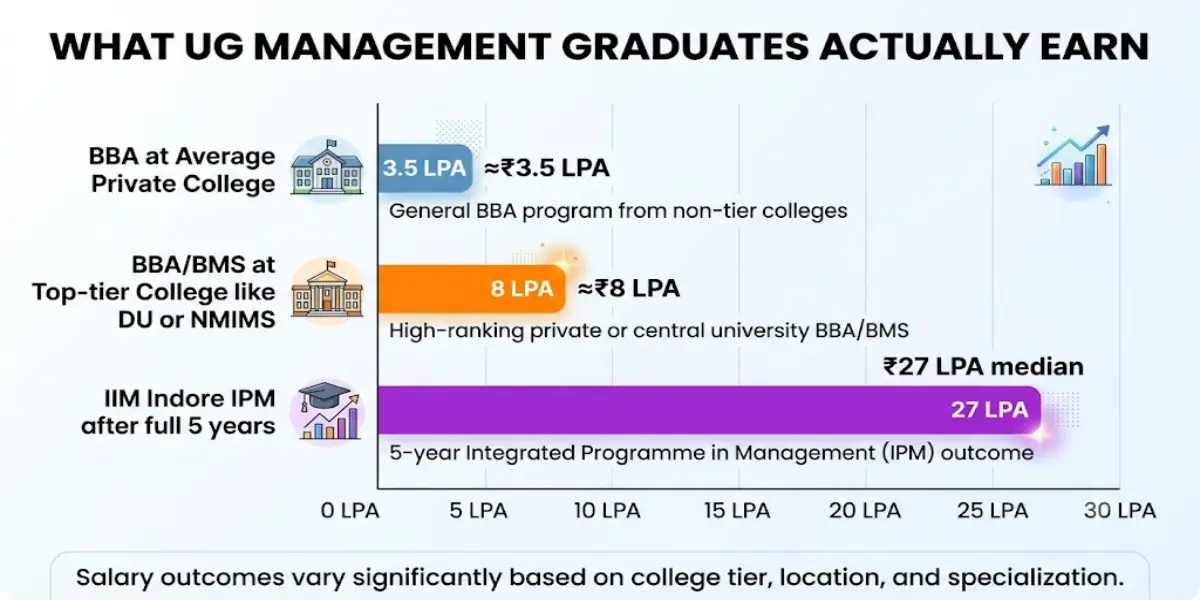
Two honest caveats. First, the IPM figure is an MBA-level salary earned after five years, not three — comparing it directly with a three-year BBA outcome flatters the IPM slightly. Second, the ₹3–4 LPA average for regular BBAs hides a wide spread: graduates who stack internships and analytics skills routinely beat it, while passive students fall below it.
Our take after reviewing placement patterns across hundreds of institution listings: the college and your internship record predict your salary far better than the course name does. A BMS graduate from DU will out-earn a BBA graduate from an unknown college almost every time — and vice versa.
Is BBA the Best Undergraduate Management Course?
It’s the best default, not the best ceiling. If you can crack IPMAT, the integrated IIM route offers the highest ceiling in Indian UG management education. If you can’t — or don’t want a five-year commitment — a BBA or BMS from a strong college, plus two serious internships, gets you to the same MBA gateway (CAT) with more flexibility.
Career opportunities after BBA remain broad: marketing and sales roles, HR, banking operations, business analysis, startup operations, and family business — plus the MBA route, where BBA graduates often hold an edge in CAT’s non-quant sections.
Eligibility, Entrance Exams, and How to Actually Get In
Can Science and Arts Students Apply?
Yes — and this surprises many families. Eligibility for undergraduate management courses in India is stream-agnostic at almost every institute: any recognised board, any stream, typically with 50–60% aggregate in Class 12.
- Science students often outperform in the quantitative sections of IPMAT and NPAT — a real edge.
- Arts and humanities students can absolutely apply for BBA; only a handful of programmes (for example, NMIMS’s BBA Finance) require mathematics or statistics in Class 12.
- Commerce students get a head start in accounting and economics papers but hold no admission advantage.
Check the maths requirement for each specific programme before applying. It’s the single most common eligibility trap.
Which Entrance Exams Are Required for Management Courses?
| Exam | Gets you into | Eligibility snapshot | Format |
|---|---|---|---|
| IPMAT | IIM Indore, IIM Rohtak (IPM) | Class 12, min. 60% (55% for reserved categories) | Aptitude test + personal interview |
| JIPMAT | IIM Bodh Gaya, IIM Jammu (IPM) | Class 12, min. 60% | NTA-conducted aptitude test |
| NPAT | NMIMS (BBA and more) | Class 12 with 60% aggregate | 120 questions, 100 minutes, no negative marking, up to 3 attempts |
| SET | Symbiosis institutes (BBA) | Class 12, min. 50% | General aptitude test |
| CUET-UG | DU BMS/BBA, central & many state universities | Class 12, varies by university | NTA computer-based test |
| CHRIST entrance / MAH-CET & state CETs | Christ University; Maharashtra BMS/BBA colleges | Class 12, varies | Institute or state-level tests |
In a typical admission cycle, IPMAT registrations open in early February and the exam is conducted in May — most other private and central exams cluster between February and June. Treat Class 12 board season and entrance prep as one combined timeline, not two.
The 4-Question Framework: Choose in 20 Minutes
Work through these in order, with your parents or counsellor in the room:
- How certain am I about management as a career — on evidence, not vibes? Certain (you’ve done a project, internship, or run something) → consider IPM/integrated. Fairly sure → BBA/BMS. Exploring → BBA (Hons) with exit options or B.Com.
- Can I commit six months to entrance prep in Class 12? Yes → target IPMAT, NPAT, SET, CUET together; their syllabi overlap heavily. No → focus on CUET plus merit-based colleges.
- What’s the realistic family budget, including hostel? Under ₹5 lakh → public universities via CUET give the best ROI. ₹10 lakh+ → add NMIMS, Symbiosis, Christ to the list. ₹25 lakh+ → the IIM IPM route enters the frame.
- Does the median placement of my shortlisted college beat its total fee within two years? If a college charges ₹10 lakh and its median (not highest) salary is ₹3.5 LPA, the maths doesn’t work. Ask every college for median figures in writing — or check our [verified BBA & BMS college directory], where we track officially reported median salary outcomes across Indian institutes.
Class 11 students: you have the biggest advantage of all — time. Start IPMAT-level quant practice now, and every exam on the table above becomes easier. Sixty minutes a week is enough to start.
Conclusion: Match the Path to Your Clarity, Not the Hype
Undergraduate management courses in India reward students who choose by evidence: a BBA or BMS from a strong college suits most students, the five-year IIM IPM route offers the highest ceiling for the fully committed, and specialised BBAs work only with proven interest. Your stream doesn’t restrict you, but the entrance exam calendar does — IPMAT, NPAT, SET, and CUET all land between February and June of Class 12. The college’s median placement and your internship record will shape your salary more than the course name ever will.
Your next step: run the 4-question framework tonight, shortlist three colleges that pass the median-salary test, and note their next exam registration deadlines in your phone calendar before you sleep.
Frequently Asked Questions
Which management course is best after 12th if I’m not sure about doing an MBA later?
A three-year BBA or BMS is the best management course after 12th when you’re undecided about an MBA. Both keep every option open — jobs, CAT, or even a pivot to analytics or law. Avoid five-year integrated programmes in this situation, since they front-load a PG commitment you’re not ready to make. Pick the strongest college you can enter, not the fanciest course name.
Can arts students apply for BBA, or is it only for commerce students?
Yes, arts students can apply for BBA at almost every Indian university. Eligibility for undergraduate management courses is stream-agnostic — any board, any stream, usually with 50–60% in Class 12. The main exception is maths-heavy variants like BBA Finance at NMIMS, which require mathematics or statistics in Class 12. Commerce students start with familiarity in accounts, but admission criteria treat all streams equally.
Which undergraduate management course has the highest salary in India?
The five-year Integrated Programme in Management (IPM) at IIM Indore currently delivers the highest salary among undergraduate management routes — a ₹29.57 LPA average and ₹27 LPA median for the 2025 batch. Remember that this is an MBA-level outcome after five years. Among three-year courses, BBA/BMS graduates from top colleges like DU, NMIMS, and Symbiosis typically start at ₹6–10 LPA.
Which entrance exams should I prepare for in Class 12 for management courses?
Prepare for IPMAT, NPAT, SET, and CUET-UG as one combined effort — their quant, reasoning, and English syllabi overlap by roughly 70–80%. IPMAT covers the IIM integrated programmes, NPAT covers NMIMS (60% eligibility, up to three attempts), SET covers Symbiosis, and CUET-UG covers DU’s BMS and most central universities. Registrations open around February, so start prep by the summer after Class 11.
What is the duration of undergraduate management courses, and can I exit early?
Most undergraduate management courses in India run three years, with NEP 2020 adding a four-year BBA (Hons) format and integrated BBA+MBA programmes running five. Many NEP-aligned universities now offer exit points — a certificate after year one, diploma after year two, degree after year three. Most IIM IPMs also permit an exit after three years with a UG degree; confirm the exact exit policy in each institute’s prospectus.
Is a specialised BBA (like analytics or aviation) better than a general BBA?
Only if you have tested proof of interest in that field — a project, internship, or sustained self-study. A specialised BBA in a growing area like business analytics can fast-track your first job, but it narrows your exits if your interest fades at 19. For most Class 12 students, a general BBA with a specialisation chosen in the final year offers a safer risk-reward balance.