

B.Sc. MLT Course Details, Eligibility, Fees, Admissions, Syllabus
- February 10, 2026

By 2026, the integration of Machine Learning (ML) and Natural Language Processing (NLP) into corporate workflows has shifted from a luxury to a baseline requirement. According to recent industry reports, over 80% of Fortune 500 companies now prioritize “AI-literacy” in their management hires. The BBA in Artificial Intelligence (Bachelor of Business Administration in AI) is the academic response to this demand, offering a specialized undergraduate path that fuses administrative expertise with high-level computational intelligence.
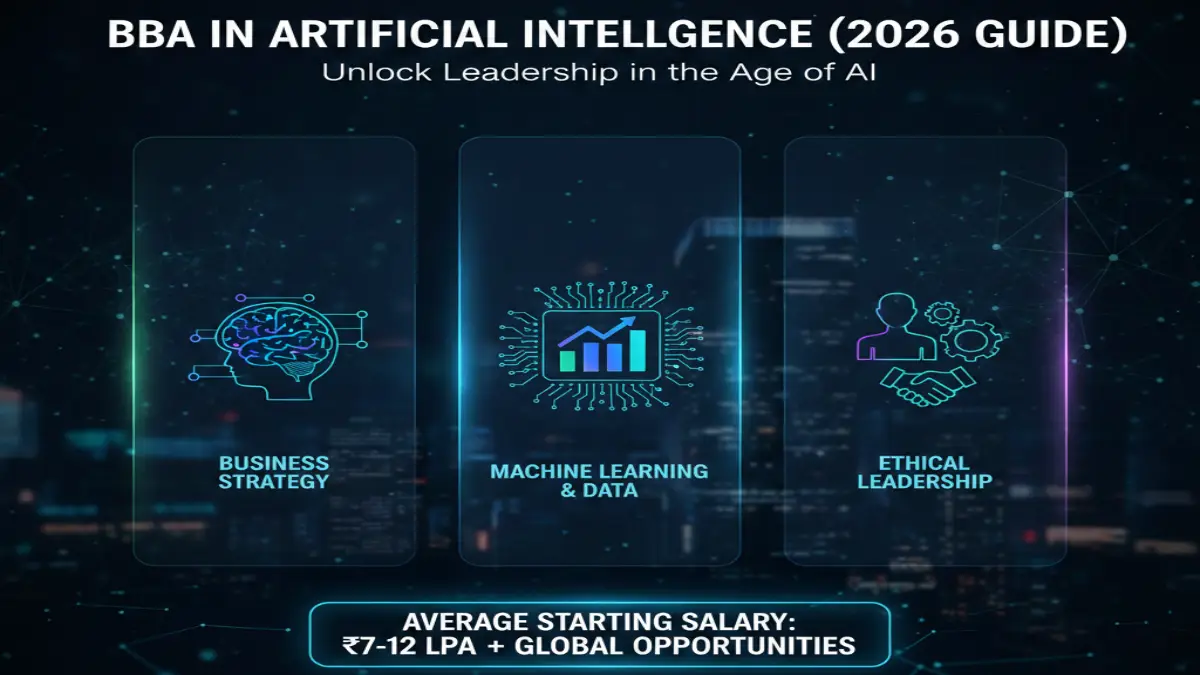
A BBA in Artificial Intelligence is a three-year professional degree designed to produce “Managerial Technologists.” Unlike traditional business degrees that rely on retrospective data, this program teaches students to use predictive AI, neural networks, and automated decision-making systems to lead organizations. It bridges the gap between the technical “how-to” of data science and the strategic “why” of business leadership.
The modern BBA Artificial Intelligence course is structured to evolve alongside the technology. Universities have transitioned from static textbooks to agile, project-based learning.
Principles of Management: Core concepts of planning, organizing, and leading.
Mathematics for AI: Linear algebra, probability, and statistics—the bedrock of algorithms.
Python for Business: Learning the primary language used to automate business reporting.
Marketing Analytics & NLP: Using sentiment analysis to gauge brand perception on social media.
FinTech & Algorithmic Trading: Understanding how AI manages portfolios and detects fraud.
Machine Learning in Supply Chain: Optimizing logistics via predictive maintenance and demand forecasting.
AI Strategy & Governance: How to implement AI at scale while maintaining corporate responsibility.
Human-AI Collaboration: Managing teams where AI agents perform 40% of the operational tasks.
Capstone Project: A mandatory semester-long internship or thesis solving a real-world business bottleneck using AI.
The Eligibility for BBA Artificial Intelligence remains accessible but competitive. To apply for the 2026-2027 academic session, students must fulfill:
Educational Threshold: Successful completion of 10+2 (Higher Secondary) from any recognized board (CBSE, ICSE, IB, or State Boards).
Minimum Aggregate: A minimum score of 50% to 60% in the qualifying exam.
Stream Requirements: While open to all streams, students with a background in Mathematics, Computer Science, or Statistics often find the technical modules more intuitive.
Top-tier institutions utilize a rigorous Admission Criteria for BBA Artificial Intelligence to ensure students can handle the dual rigor of tech and management.
Entrance Examinations: High percentiles in exams like CUET (UG), IPMAT (IIM Indore/Rohtak), NPAT (NMIMS), or SET (Symbiosis).
Psychometric Testing: Some colleges now include logic and pattern recognition tests.
Personal Interview (PI): A critical round where faculty assess a student’s vision for using technology in business.
When selecting an institution, focus on those with “Center of Excellence” labs and active industry tie-ups. Here are the Top Colleges for BBA Artificial Intelligence in India for 2026:
| Institution Name | Location | Industry Partner | Estimated Annual Fees |
| SVKM’s NMIMS | Mumbai/Bangalore | Microsoft/AWS | ₹3.5L – ₹4.5L |
| Chandigarh University | Punjab | IBM | ₹1.8L – ₹2.2L |
| Symbiosis (SSPU) | Pune | Specialized AI Wing | ₹2.5L – ₹3.0L |
| Amity University | Noida | Oracle/Google | ₹3.0L – ₹4.0L |
| UPES | Dehradun | Tech Mahindra | ₹2.8L – ₹3.5L |
The Fees Structure for this degree is generally 20-30% higher than a standard BBA due to specialized software licenses, high-compute labs, and faculty with industry expertise.
Government Sector: Fees range from ₹40,000 to ₹1.2 Lakhs for the entire program.
Private Sector: Fees range from ₹6 Lakhs to ₹15 Lakhs for the three-year duration.
ROI Factor: Graduates typically recoup their investment within 1.5 to 2 years of employment.
The horizon for Career Opportunities after BBA Artificial Intelligence is vast, as every sector—from healthcare to hospitality—is undergoing an AI makeover.
AI Operations Manager: Overseeing the integration of automated workflows within a company.
Business Intelligence (BI) Developer: Creating dashboards that translate AI findings into actionable executive decisions.
AI Product Manager: Guiding the development of user-facing AI tools (like chatbots or recommendation engines).
Data Privacy & Ethics Officer: Ensuring the company’s AI usage complies with international laws like GDPR or India’s DPDP Act.
Digital Transformation Consultant: High-paying roles in firms like McKinsey, BCG, or Deloitte, helping traditional companies modernize.
The BBA in Artificial Intelligence is no longer a “niche” degree—it is the gold standard for modern business education. By choosing this path, you secure a future-proof career that combines the stability of management with the explosive growth of the tech sector.
It depends on your career goal. Choose B.Tech if you want to build the underlying code and infrastructure. Choose BBA AI if you want to apply that technology to solve business problems and lead teams.
In 2026, entry-level salaries in India range between ₹7 LPA and ₹12 LPA. With 3–5 years of experience, these figures often double in the consulting and fintech sectors.
No. You need a logical mind. While the course involves statistics and algebra, the focus is on interpreting results and making decisions, not manual complex theorem proofs.
Yes. The curriculum is globally standardized. Many students pursue an MS in Business Analytics or an MBA in the USA, UK, or Germany, where AI-management roles are in high demand.
The “Power Trio” of skills includes Critical Thinking, Data Visualization, and Prompt Engineering. Being able to effectively communicate with both machines and humans is your greatest asset.
Yes, as long as you pursue it from a UGC-recognized university, the degree is valid for all government exams (UPSC, SSC) and higher education globally.