
How to Prepare for JEE Main 2027- The Complete Preparation Roadmap
Last Updated on August 2, 2026 by Vinod Saini
Quick answer: JEE Main 2027 will run in two sessions — Session 1 in the last week of January 2027 and Session 2 in the first week of April 2027 — testing Physics, Chemistry, and Mathematics across 75 attempted questions (300 marks) in 3 hours. The 2026 general-category qualifying cutoff was 93.41 percentile, up from 90.78 in 2023, and a safe score for a top NIT CSE seat now sits around 95+ percentile (170–220+ marks). Beating that trend takes a syllabus-first study plan, weekly full-length mocks, and disciplined PYQ analysis — not last-minute cramming.
Back in 2019, JEE Main aspirants planned their year around a single attempt, paper-based mock series, and a syllabus that hadn’t been trimmed. None of that is true anymore. The exam now runs twice a year, NTA has rationalised the syllabus, questions come in a mixed MCQ-plus-numerical format, and the qualifying cutoff keeps climbing as more students appear each cycle.
If you’re still preparing the way a 2019 guide told you to, you’re solving a different exam than the one you’ll actually sit for in 2027.
This guide rebuilds the preparation plan from scratch for JEE Main 2027: the current exam pattern, subject-wise weightage, a realistic month-by-month timeline whether you’re starting today or six months from the exam, the percentile you actually need for your target college, and the mistakes that quietly cost most aspirants a full percentile band.
Why the Old JEE Main Playbook No Longer Works
Three structural changes separate JEE Main 2027 from the exam older guides were written for.
- The syllabus is leaner. NTA rationalised the syllabus in recent cycles, dropping several topics that used to eat up revision time without carrying real weightage. Studying from an old chapter list means wasting hours on content that won’t appear on your paper.
- You get two shots, not one. Session 1 (January) and Session 2 (April) let you appear in either or both, and NTA considers your best score across sessions. That changes the entire risk calculus — a bad Session 1 is now a data point, not a disaster.
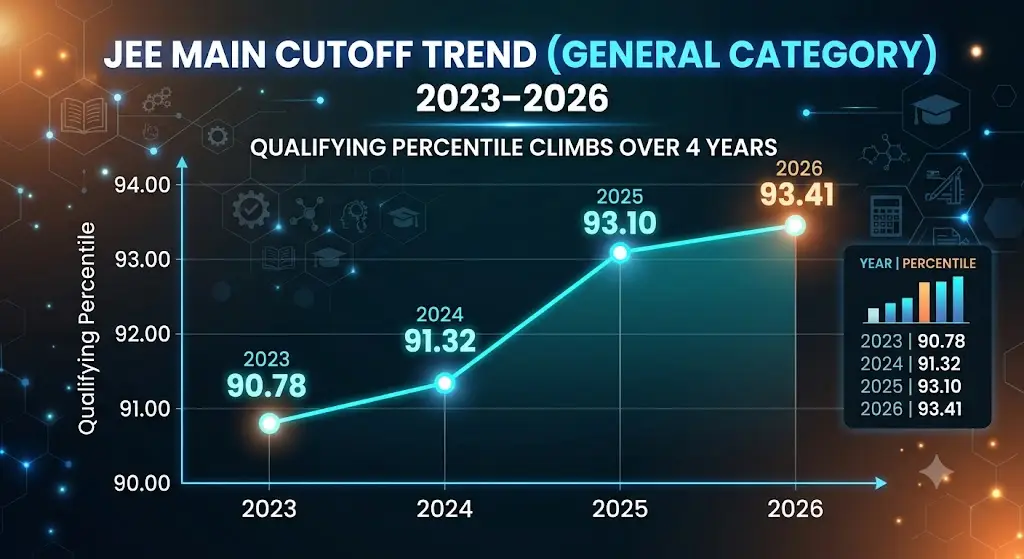
- The cutoff keeps rising. The General category qualifying percentile moved from 90.78 in 2023 to 93.10 in 2025 to 93.41 in 2026. More candidates, tighter normalisation, and improved average preparation mean the bar for JEE Advanced eligibility — and for a good NIT seat — goes up almost every year. Planning around last year’s cutoff already puts you behind.
Treat every 2024, 2025, or 2026 cutoff number you read as a floor, not a target. Aim at least one full percentile band above the most recent published cutoff for your category.
JEE Main 2027: Exam Pattern, Dates, and Syllabus at a Glance
Exam Pattern (Paper 1 — B.E./B.Tech.)
| Feature | Detail |
|---|---|
| Mode | Computer-Based Test (CBT) |
| Duration | 3 hours |
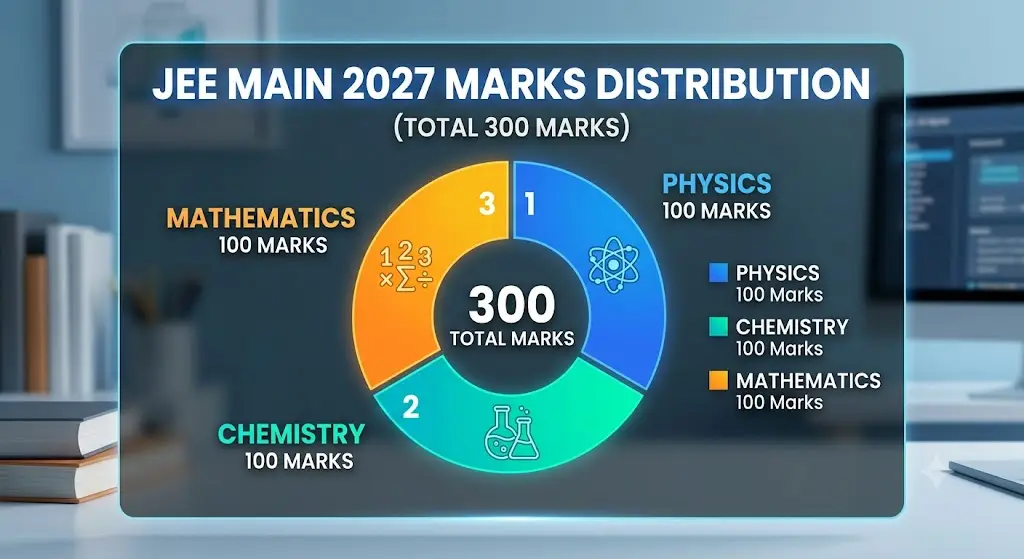
| Total questions | 90 (30 per subject) |
| Questions to attempt | 75 (25 per subject) |
| Format per subject | 20 MCQs (all compulsory) + 10 Numerical Value Questions (attempt any 5) |
| Marking | +4 correct, −1 incorrect (MCQ and NVQ alike), 0 for unattempted |
| Total marks | 300 |
| Languages | 13 regional languages plus English and Hindi |
Pattern based on the JEE Main 2026 information bulletin; NTA typically confirms the 2027 bulletin around October 2026 — recheck the official JEE Main portal before finalising your strategy.
Expected Dates
- Session 1: Last week of January 2027
- Session 2: First week of April 2027
- Application window: Expected to open around October 2026 for Session 1
- Candidates can appear in one or both sessions; NTA carries forward the better normalised score.
Subject-Wise Weightage
| Subject | Section A (MCQ) | Section B (NVQ) | Total Questions | Marks |
|---|---|---|---|---|
| Mathematics | 20 | 5 (of 10, choose any 5) | 25 | 100 |
| Physics | 20 | 5 (of 10, choose any 5) | 25 | 100 |
| Chemistry | 20 | 5 (of 10, choose any 5) | 25 | 100 |
High-weightage areas worth prioritising early:
- Chemistry: Coordination Compounds, Chemical Bonding, Chemical Equilibrium, General Organic Chemistry (GOC), Aldehydes, Ketones and Carboxylic Acids.
- Mathematics: Calculus, Coordinate Geometry, Vectors and 3D Geometry, Algebra.
- Physics: Mechanics, Electrodynamics, and Modern Physics consistently carry the heaviest share across recent papers.
Starting your syllabus mapping today? Cross-check the NTA-released syllabus PDF (published every October on the official portal) against whatever chapter list your coaching material uses — mismatches between an outdated list and the current syllabus are one of the most common, avoidable losses of prep time.
The JEE Main 2027 Preparation Timeline: Pick Your Track
The right plan depends entirely on how much runway you have. Don’t copy a 12-month plan onto a 4-month timeline — it will just make you feel behind.
| Time left | Primary focus | Weekly rhythm |
|---|---|---|
| 12+ months (starting Class 11) | Build concepts chapter-by-chapter with NCERT first, then a standard reference book. No mocks yet — focus on accuracy over speed. | 5–6 days concept study, 1 day light revision + subject-wise topic tests |
| 6–8 months | Finish remaining syllabus by month 3, then shift fully to revision, PYQs, and mocks for the rest. | 4 days new topics, 2 days mixed PYQ practice, 1 full mock every 10–14 days |
| 3–4 months | Triage: identify your weakest 30% of chapters by weightage and fix only what moves your score. Stop chasing 100% syllabus coverage. | 2 days targeted revision, 3 days PYQ + error-log review, 2 full mocks per week |
| Final 4–6 weeks | No new topics. Pure mock tests, error-log closure, and formula revision. | Alternate full mocks with focused weak-area drilling; sleep and timing discipline matter as much as content now |
[Insert Infographic: “6-Month JEE Main Study Roadmap” — horizontal timeline showing month-by-month focus shifting from concept-building to full-syllabus revision to pure mock-test mode]
The honest reality most guides skip: if you’re inside the final 4 months and haven’t finished the syllabus, finishing it completely is usually the wrong goal. A student who masters 70% of the syllabus at 90% accuracy consistently outscores one who rushes through 100% of it at 60% accuracy. Triage ruthlessly — use the weightage table above to decide what earns your remaining hours.
Subject-Wise Strategy That Actually Moves Your Percentile
Physics: Fewer Formulas, More Application
Physics punishes formula-memorisation without conceptual grounding. Numerical Value Questions in particular reward students who can set up a problem correctly, not just recall an equation.
- Build a single formula sheet per chapter as you study — not at the end. Revisiting it during PYQ practice cements recall far better than a last-week cram sheet.
- Mechanics and Electrodynamics carry the most weight; if you can only deep-dive two areas, make it these two.
- Practise previous years’ NVQ-style questions specifically — they’re scored identically to MCQs but many students under-practise them because they feel less familiar. Try our JEE Main Physics mock tests to build this habit early.
Chemistry: The Highest ROI Subject in the Paper
Chemistry is the fastest subject to improve because a large share of Inorganic and Organic Chemistry is direct recall, not derivation.
- Inorganic Chemistry (Coordination Compounds, Periodic Properties, Chemical Bonding) rewards flashcard-style repetition more than any other section of the paper — treat it as memorisation work, not problem-solving work.
- Physical Chemistry (Equilibrium, Thermodynamics, Electrochemistry) needs formula fluency and unit-consistency practice.
- Organic Chemistry, especially GOC and Aldehydes/Ketones/Carboxylic Acids, rewards mechanism-based understanding over rote reaction lists. Practice with our JEE Main Chemistry mock tests
Mathematics: Speed Is the Actual Bottleneck
Most JEE Main aspirants understand the mathematics they’re tested on; they simply run out of time executing it under exam pressure.
- Time every practice set, not just full mocks. If a Calculus problem takes you four minutes in practice, it will take five under exam stress — build in that buffer.
- Coordinate Geometry and Vectors/3D Geometry are high-weightage and largely formula-driven — strong ROI for focused revision in the final weeks.
- Keep a running “silly mistake” log. Sign errors, misread questions, and calculation slips typically cost far more marks over a full attempt than genuine conceptual gaps. Sharpen your speed with our JEE Main Maths mock tests.
What Percentile Do You Actually Need? (2026 Data and the 2027 Trend)
JEE Main Category-Wise Qualifying Cutoff (2026)
| Category | 2026 Qualifying Percentile |
|---|---|
| General | 93.41 |
| EWS | 80–82 |
| OBC-NCL | 79–81 |
| SC | 61–63 |
| ST | 47.5–50 |
| PwD | 0.001–0.02 |
The General category cutoff has climbed every recorded cycle — 90.78 (2023) → 93.10 (2025) → 93.41 (2026) — so treat 2026’s number as a minimum, not a target, for 2027.
Percentile You Need for Admission (Not Just Qualification)
Qualifying for JEE Advanced eligibility is a much lower bar than getting the NIT seat you actually want. Don’t confuse the two.
| Target percentile | Approximate rank | Realistic outcome |
|---|---|---|
| 95%+ | Top 2,000–5,000 | Top 5 NIT CSE / IIT possible (lower branches) |
| 93–95% | 5,000–15,000 | Guaranteed NIT seat (any branch), Top 10 NIT CSE possible |
| 90–93% | 15,000–50,000 | Tier-2 NIT CSE / Tier-1 NIT non-CSE |
| 88–90% | 50,000–1,00,000 | Mid-tier NIT seats / top IIIT non-CSE |
In marks terms, a score of roughly 170–220+ out of 300 has stayed a safe zone for top NITs and IIITs across the last two cycles. Use marks as your internal benchmark during mock practice rather than chasing a moving percentile target, since the marks-to-safe-zone relationship has stayed fairly stable even as raw difficulty shifts session to session.
Common JEE Main Preparation Mistakes That Quietly Cost a Percentile Band
- Studying from an outdated syllabus list. Old PDFs and hand-me-down chapter notes often still include topics NTA has since dropped. Always cross-check against the current official syllabus.
- Treating both sessions as a safety net without a real Session 1 attempt. Some students under-prepare for January, planning to “really try” in April. A genuine Session 1 attempt gives you real exam-condition data that no mock test replicates — skipping that data hurts your April performance.
- Full-syllabus revision with no error log. Re-reading notes feels productive but rarely fixes the specific mistakes costing you marks. A simple log of every wrong answer, tagged by cause (concept gap, silly mistake, time pressure), is one of the highest-leverage habits a JEE aspirant can build.
- Ignoring NVQs in practice. Because they don’t offer answer choices to eliminate against, many students under-practise Numerical Value Questions relative to their actual weight in the paper (10 per subject, attempt any 5).
- Chasing 100% syllabus coverage in the final month. As covered above, this is often a net negative if it comes at the cost of mock-test frequency and error-log closure.
- No sleep or timing discipline before mocks. Full-length mocks taken half-focused, late at night, or without matching real exam timing produce data that doesn’t transfer to exam day.
The PYQ + Mock Test Framework
A practical framework for anyone past the concept-building stage:
- Weeks with new content: 1 full mock every 10–14 days, timed strictly.
- Pure revision phase (final 6–8 weeks): 2 full mocks per week, alternating sessions (morning/afternoon) to mirror your actual exam slot’s energy levels.
- After every mock: spend at least as much time reviewing errors as you spent taking the test. Tag every miss as a concept gap, silly mistake, or time-pressure error — this single habit typically closes more of the score gap than solving new questions.
- Last 2 weeks: stop attempting brand-new question types. Re-attempt only your logged errors and previous mocks under time pressure, using our full-length JEE Main mock test series. (verify/replace with your actual mock test URL)
Conclusion
JEE Main 2027 rewards students who prepare for the exam as it exists today — a leaner syllabus, two normalised sessions, and a qualifying cutoff that keeps climbing — not the exam described in older guides. Match your timeline honestly to how much runway you have, prioritise Chemistry and high-weightage Physics/Maths chapters for the fastest score gains, and let weekly mocks with a real error log drive your final months, not blind revision.
Your next step: pick your timeline track from the table above, download the current NTA syllabus PDF, and schedule your first full mock for this coming weekend.
Frequently Asked Questions
How should I start preparing for JEE Main 2027?
Start by downloading the current official NTA syllabus and matching it against your study material, since older chapter lists still include topics NTA has since removed. Then build a timeline based on your actual runway (12+ months, 6–8 months, or 3–4 months) rather than a generic one-size-fits-all study plan, and begin with NCERT before moving to reference books.
How many hours should I study daily for JEE Main?
Most successful aspirants study 5–8 focused hours daily outside school or coaching hours, prioritising quality and consistency over raw hour count. A student studying 5 focused hours with active problem-solving and error review typically outperforms one studying 8 passive hours of re-reading notes.
Is it possible to crack JEE Main in 6 months?
Yes, a 6–8 month timeline is realistic if you triage the syllabus by weightage, finish new topics within the first 2–3 months, and dedicate the remainder to PYQs, error-log review, and weekly full mocks. It requires disciplined execution rather than covering every topic in exhaustive depth.
What percentile is required for a good NIT in JEE Main 2027?
Based on the 2026 trend, a 93–95 percentile generally secures a guaranteed NIT seat in some branch, while 95%+ is needed for a realistic shot at a top-5 NIT’s CSE branch. Since the General category cutoff has risen every cycle (90.78 in 2023 to 93.41 in 2026), treat these as floors and aim higher where possible.
Should I appear for both JEE Main sessions?
Yes, appearing in both sessions is generally advisable since NTA considers your best normalised score across attempts, and a January attempt gives you genuine exam-day data — question difficulty, time pressure, and personal performance under real conditions — that no mock test fully replicates.
Which subject should I focus on if I’m short on time?
Chemistry typically offers the fastest score improvement for time-constrained students because a large share of Inorganic Chemistry is direct recall rather than multi-step problem-solving, making it highly responsive to focused, short-burst revision in the final weeks. Test this with our JEE Main Chemistry mock tests.
Leave a Reply