
Top Law Colleges in India: Rankings, Fees & Admission 2026
Last Updated on July 25, 2026 by Vinod Saini
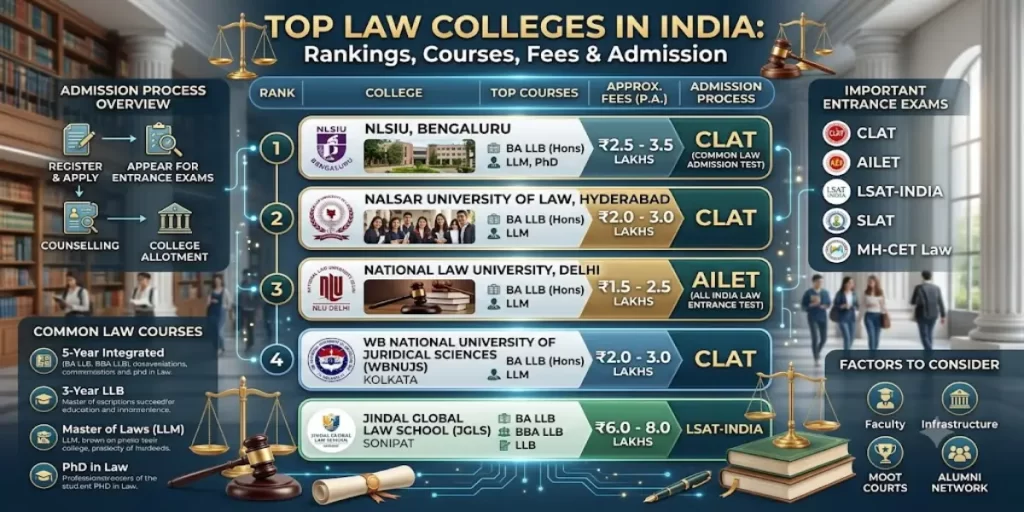
⚡Quick Answer: The top 3 law colleges in India by NIRF 2025 are NLSIU Bangalore (#1), NLU Delhi (#2), and NALSAR Hyderabad (#3). Five-year course fees range from ₹7L (RGNUL Patiala) to ₹31.25L (Jindal Global Law School). The primary entrance exam is CLAT – accepted by most NLUs. NLU Delhi uses its own test, AILET. CLAT 2026 was held in December 2025; counselling and seat allotment run January–March 2026.
Note on Eligibility: 5-year integrated programmes (BA LLB / BBA LLB) are for Class 12 pass-outs. 3-year LLB programmes (like DU Law or GLC Mumbai) require an existing undergraduate degree in any discipline.
India has over 1,700 law institutions. Most of them aren’t worth your time. This guide focuses on what actually matters: the best law colleges in India by NIRF 2025 rank, verified fee data, entrance exam requirements, and honest placement context – so you can compare and decide without wading through noise.
Top Law Colleges in India – NIRF 2025 Rankings at a Glance
The NIRF Law Ranking 2025 evaluates institutions on teaching quality, research output, graduation outcomes, and peer perception. The top 5 are all NLUs. The first private college (Symbiosis Law School, Pune) appears at rank 7.
| NIRF Rank | College Name | Location | Type | 5-Year Fees (approx.) | Entrance Exam |
|---|---|---|---|---|---|
| 1 | National Law School of India University (NLSIU) | Bangalore, Karnataka | Govt (NLU) | ₹22.69L | CLAT |
| 2 | National Law University (NLU Delhi) | New Delhi | Govt (NLU) | ₹20–21L | AILET |
| 3 | NALSAR University of Law | Hyderabad, Telangana | Govt (NLU) | ₹13.5–15.35L | CLAT |
| 4 | WBNUJS | Kolkata, West Bengal | Govt (NLU) | ₹13.2–16.8L | CLAT |
| 5 | Gujarat National Law University (GNLU) | Gandhinagar, Gujarat | Govt (NLU) | ₹13.6L | CLAT |
| 6 | IIT Kharagpur (RGSOIPL) | Kharagpur, West Bengal | Govt | – | GATE/CUET |
| 7 | Symbiosis Law School | Pune, Maharashtra | Private | ₹25.3L | SLAT |
| 8 | Jamia Millia Islamia | New Delhi | Govt (Central Univ.) | Low (govt fees) | CUET / JMI Entrance |
| 9 | Aligarh Muslim University (AMU) | Aligarh, UP | Govt (Central Univ.) | Low (govt fees) | AMU Entrance |
| 10 | NLU Jodhpur | Jodhpur, Rajasthan | Govt (NLU) | ₹15–18.5L | CLAT |
| 11 | SASTRA University | Thanjavur, Tamil Nadu | Private | – | CLAT / Merit |
| 12 | Babasaheb Bhimrao Ambedkar University | Lucknow, UP | Govt | – | CUET |
| 13 | CUSAT | Kochi, Kerala | Govt | – | KLEE / CUSAT CAT |
| 14 | KIIT School of Law | Bhubaneswar, Odisha | Private | – | KIIT LAT |
| 15 | NLU Odisha (NLUO) | Cuttack, Odisha | Govt (NLU) | – | CLAT |
Note: Fees shown are approximate 5-year totals including tuition, hostel, and mess where available. Always verify with the official college fee schedule before applying.
Top National Law Universities (NLUs) in India
National Law Universities are the tier 1 law colleges in India. There are 24 NLUs across the country, established by state acts and funded by state governments. They offer the BA LLB (5-year integrated) and LLM programmes, and most admit students through a single national exam: CLAT (Common Law Admission Test), conducted by the Consortium of NLUs.
The only exception is NLU Delhi, which runs its own test, AILET.
NLUs are the first choice for serious law aspirants because of peer quality, placement outcomes, and brand recognition in the legal profession. CLAT 2025 cutoff ranks (General category, closing round) give you a realistic sense of how competitive each NLU is.
1. National Law School of India University (NLSIU), Bangalore
- NIRF 2025 Rank: #1 (score: 82.97) – 8th consecutive year at the top
- Location: Bangalore, Karnataka
- 5-Year Fees (BA LLB): ₹22.69L (₹4.51L/year + ₹13,900 one-time admission fee)
- Courses: BA LLB (Hons.), LLM, PhD
- CLAT 2025 Cutoff (General): approx. 100 rank
- Avg. Placement: ₹16–18 LPA (median); top offers at ₹45 LPA
NLSIU is the undisputed #1 among the best law schools in India. Founded in 1987, it pioneered the 5-year integrated law degree format that every NLU now follows. The peer quality here is unlike anywhere else – students who clear CLAT in the top 100 are intensely competitive and research-driven. Recruiters from Tier 1 law firms, the Bar, and public policy organisations show up every year.
2. National Law University, Delhi (NLU-D)
- NIRF 2025 Rank: #2 (score: 80.00)
- Location: New Delhi
- 5-Year Fees (BA LLB): ₹20–21L (₹3.95–4.15L/year including hostel and mess)
- Courses: BA LLB (Hons.), BCom LLB (Hons.), LLM, PhD
- Entrance Exam: AILET (not CLAT – this is the key distinction)
- Avg. Placement: ₹18 LPA (median UG); highest reported at ₹25 LPA
NLU Delhi is the only top NLU that doesn’t participate in CLAT counselling. AILET is a separate exam with its own registration, syllabus, and calendar – plan accordingly. The Delhi location is a significant advantage: proximity to the Supreme Court, Delhi High Court, top law firms, and policy institutions means internship access is exceptional. Consistently one of the best LLB colleges in India for corporate law careers.
3. NALSAR University of Law, Hyderabad
- NIRF 2025 Rank: #3 (score: 79.50)
- Location: Hyderabad, Telangana
- 5-Year Fees (BA LLB): ₹13.5–15.35L (₹2.67–3.17L/year)
- Courses: BA LLB (Hons.), LLM, PhD
- CLAT 2025 Cutoff (General): approx. 150 rank
- Standout: Strong constitutional law and policy track; active alumni network in litigation and public service
NALSAR is the third pillar of India’s top law universities. Fees are significantly lower than NLSIU and NLU Delhi, making it one of the best BA LLB colleges in India on a value-for-money basis. The Hyderabad campus has a strong mooting culture and a well-regarded journal ecosystem.
4. West Bengal National University of Juridical Sciences (WBNUJS), Kolkata
- NIRF 2025 Rank: #4 (score: 79.39)
- Location: Kolkata, West Bengal
- 5-Year Fees (BA LLB): ₹13.2–16.8L (academic fees only: approx. ₹13.29L; all-inclusive: approx. ₹16.8L)
- Courses: BA LLB (Hons.), BSc LLB (Hons.), LLM
- CLAT 2025 Cutoff (General): approx. 285–327 rank
- Standout: One of the oldest NLUs; strong legacy in corporate law, mooting, and legal research
WBNUJS is a consistent top-4 finisher in NIRF law rankings. The Kolkata location gives students access to the Calcutta High Court – one of India’s oldest – and a strong local bar. CLAT cutoff around 300 makes it more accessible than the top 3, while the academic quality remains firmly tier 1.
5. Gujarat National Law University (GNLU), Gandhinagar
- NIRF 2025 Rank: #5
- Location: Gandhinagar, Gujarat
- 5-Year Fees (BA LLB): ₹13.6L (₹2.72L/year including mess; one-time ₹17,000 at admission)
- Courses: BA LLB (Hons.), BBA LLB (Hons.), LLM
- CLAT 2025 Cutoff (General): approx. 402–444 rank
- Standout: Strong research output, diverse academic ecosystem, growing industry partnerships with Gujarat’s corporate sector
GNLU has climbed steadily in the law colleges ranking in India. The Gandhinagar campus is modern and well-resourced. At ₹13.6L total, it’s one of the most affordable top-5 NLUs – a real consideration for families comparing cost vs. outcome.
6. National Law University, Jodhpur (NLU Jodhpur)
- NIRF 2025 Rank: #10
- Location: Jodhpur, Rajasthan
- 5-Year Fees (BA LLB): ₹15–18.5L (₹3.05L/year in tuition; hostel and mess extra)
- Courses: BA LLB (Hons.), BBA LLB (Hons.), LLM
- CLAT 2025 Cutoff (General): approx. 357–367 rank
- Standout: Known for corporate and business law specialisation; strong placement record with Tier 1 and Tier 2 law firms
NLU Jodhpur is one of the best-regarded mid-tier NLUs and a consistent top-10 finisher. Business law and IP law are particular strengths – the curriculum has a noticeably commercial orientation compared to other NLUs.
7. National Law Institute University (NLIU), Bhopal
- NIRF 2025 Rank: #27 (score: 57.64)
- Location: Bhopal, Madhya Pradesh
- 5-Year Fees (BA LLB): ₹14.3L (₹2.86L/year)
- Courses: BA LLB (Hons.), LLM
- CLAT 2025 Cutoff (General): approx. 600–700 rank range
- Standout: One of the older NLUs (est. 1997); strong alumni presence in the Madhya Pradesh bar and judiciary
NLIU Bhopal is a solid mid-tier NLU. The NIRF rank has slipped in recent years, but the institution retains credibility in central India’s legal market. A good option if you’re targeting state-level practice or the MP judiciary.
8. Dr. Ram Manohar Lohiya National Law University (RMLNLU), Lucknow
- NIRF 2025 Rank: #21
- Location: Lucknow, Uttar Pradesh
- 5-Year Fees (BA LLB): ₹10.25L (₹2.05L/year tuition; mess charges extra at approx. ₹4,000–4,500/month)
- Courses: BA LLB (Hons.), LLM
- CLAT 2025 Cutoff (General): approx. 800–1,000 rank range
- Standout: Most affordable top-25 NLU; strong connections to the Allahabad High Court and UP bar
RMLNLU is the value pick among NLUs. ₹10.25L for a 5-year NLU degree is genuinely hard to beat. The Lucknow location is a plus for students interested in litigation – the Allahabad High Court bench in Lucknow is one of the busiest in the country.
Top Private Law Colleges in India
Private law colleges aren’t a fallback. For students who miss NLU cutoffs, or who specifically want international exposure, global faculty, or specialisations that NLUs don’t offer, the best private law schools in India are legitimate first choices.
Three situations where private makes sense: you want international law or global moot court culture; you need a specific specialisation (IP, sports law, media law) that NLU curricula don’t cover well; or you’re targeting a Delhi NCR or Pune location for internship access without the CLAT pressure.
1. Jindal Global Law School (JGLS), Sonipat
- NIRF Rank: Not ranked in NIRF Law category (participates in University ranking)
- QS World Ranking (Law): #35 globally (2026) – the only Indian law school in the global top 50
- Location: Sonipat, Haryana (NCR)
- 5-Year Fees (BA LLB): ₹31.25L (₹6.25L/year)
- Courses: BA LLB, BBA LLB, LLM, PhD
- Entrance: JSAT (Jindal Scholastic Aptitude Test) / CLAT / direct university assessment. Note: LSAT India has been discontinued by LSAC and is no longer accepted.
- Avg. Placement: ₹12–15 LPA (estimated; no audited official report)
JGLS is India’s most internationally recognised private law school. The faculty includes former practitioners from the UK, US, and Europe. Moot court culture is exceptional – JGLS teams regularly compete and win at international competitions like the Jessup and Vis Moot. The ₹31.25L price tag is the highest on this list; weigh it against the global brand and international law career potential.
2. Symbiosis Law School (SLS), Pune
- NIRF 2025 Rank: #7 (score: 74.07) – highest-ranked private law college in India
- Location: Pune, Maharashtra
- 5-Year Fees (BA LLB / BBA LLB): ₹25.3L (₹5.06–5.26L/year)
- Courses: BA LLB (Hons.), BBA LLB (Hons.), BCom LLB (Hons.), LLM
- Entrance: SLAT (Symbiosis Law Admission Test) + Personal Interaction round
- Avg. Placement: ₹13.31 LPA (2025); highest domestic: ₹22 LPA; highest international: ₹52 LPA
SLS Pune is the top private law college in India by NIRF 2025 – and it’s not close. The corporate law track is the strongest in the private sector, with consistent recruiter interest from Tier 1 and Tier 2 firms. SLAT is a separate exam from CLAT; registration opens typically in October–November for the following academic year.
3. Christ University School of Law, Bangalore
- NIRF 2025 Rank: #24 in Law category; #96 Overall
- Location: Bangalore, Karnataka
- 5-Year Fees (BA LLB): ₹14.15–14.23L (₹2.83L/year; hostel extra)
- Courses: BA LLB (Hons.), BBA LLB (Hons.), LLM
- Entrance: Christ University’s own entrance test (not to be confused with NTA’s CUET) / merit-based
- Avg. Placement: ₹6–7 LPA (UG median: ₹6L per NIRF 2024 data)
Christ University is the go-to private option for South India students who want a Bangalore location without NLU fees. At ₹14.15L, it’s priced comparably to mid-tier NLUs but with a private university’s campus infrastructure. Strong for students targeting Karnataka’s bar or corporate sector in Bangalore.
4. Amity Law School, Delhi
- NIRF Rank: Not ranked in NIRF Law (Amity University Haryana/Gurugram is ranked #39 in Law)
- Location: Noida / New Delhi, NCR
- 5-Year Fees (BA LLB): approx. ₹12.6–13.3L (varies by campus)
- Courses: BA LLB (Hons.), BBA LLB (Hons.), LLM
- Entrance: CLAT / Amity’s own test / merit-based
- Standout: Large alumni network in Delhi NCR; good for students who want a private law degree in the capital region with access to Delhi courts and law firms
Amity Law School is a well-known private option in Delhi NCR. It’s not in the same league as JGLS or SLS Pune on placement outcomes, but the Delhi location and large alumni base are practical advantages for students targeting litigation or corporate roles in the capital.
Top Government Law Colleges in India (Non-NLU)
Not every strong law college is an NLU. Several government and central university law faculties have long track records, lower fees, and strong local bar connections.
1. Faculty of Law, University of Delhi (DU Law)
- Location: New Delhi
- Fees (LLB 3-year): approx. ₹18,030 total (one of the most affordable law programmes in India)
- Fees (BA LLB 5-year Hons.): approx. ₹9.5–10.4L
- Courses: LLB (3-year), BA LLB (Hons.), LLM
- Entrance: CUET / DU entrance process
- Avg. Placement: ₹4–7.5 LPA
DU Law operates outside the NLU system but competes with the best of them on real-world outcomes. The 3-year LLB at under ₹20,000 total fees is extraordinary value – and the DU brand, Delhi location, and Supreme Court proximity make it a serious option for litigation-focused students. The BA LLB (Hons.) is newer and more competitive. Some third-party summaries place DU Law near the top 10 in NIRF Law, but this is not confirmed in the official NIRF list – treat the rank claim with caution and rely on the programme’s own track record.
2. Government Law College (GLC), Mumbai
Established in 1855, GLC Mumbai is the oldest law college in Asia. It runs a 5-year BA LLB programme with fees under ₹61,000 total (aided category: approx. ₹30,000). Alumni include some of India’s most prominent advocates and judges. Placement averages are modest (₹7–8 LPA in recent disclosed batches), but the Mumbai bar connection is unmatched.
3. ILS Law College, Pune
One of Maharashtra’s most respected non-NLU law colleges. BA LLB total fees are approximately ₹2–4L depending on the fee component counted. Admission is through MH CET Law. Strong for students targeting the Bombay High Court’s Pune bench and Maharashtra’s legal market.
4. Jamia Millia Islamia, New Delhi (NIRF #8)
A central university with a strong law faculty. NIRF rank 8 puts it ahead of many NLUs. Admission through CUET / JMI Entrance. Fees are government-level (low). The Delhi location is a major advantage.
Why consider these over NLUs: Lower fees, strong connections to the local bar and state judiciary, and often better access to litigation internships. If your goal is to practise in a specific state or city, a well-regarded government college in that location can outperform a lower-ranked NLU in a different city.
Entrance Exams for Top Law Colleges in India
| Exam | Conducting Body | Colleges Accepting | Approx. Exam Date | Mode |
|---|---|---|---|---|
| CLAT | Consortium of NLUs | 23 NLUs + many private/govt colleges | December (for next academic year) | Offline (Pen & Paper / OMR) |
| AILET | NLU Delhi | NLU Delhi only | December | Offline (Pen & Paper / OMR) |
| SLAT | Symbiosis International University | All Symbiosis Law Schools | December (2 attempts) | Online (CBT) |
| MH CET Law | Maharashtra State CET Cell | Maharashtra govt and private law colleges | May–June | Online (CBT) |
| CUET | NTA | Central universities (Jamia, BHU, AMU, DU) | May–June | Online (CBT) |
CLAT is the most important exam. A single CLAT score gives you access to 23 NLUs and dozens of other colleges. Prepare for CLAT first; AILET and SLAT can be added as parallel attempts with minimal extra prep since the syllabus overlaps significantly.
Note on exam mode: Unlike most Indian competitive exams, CLAT and AILET remain strictly offline, pen-and-paper (OMR-based) tests. Practise bubbling OMR sheets under timed conditions – it’s a different skill from clicking answers on a screen. Also note that LSAT India has been discontinued by the Law School Admission Council (LSAC) from the 2025 admission cycle onwards; it is no longer an entry route for Indian law colleges.
CLAT 2026 was conducted in December 2025. The next cycle (CLAT 2027) will open registrations around August–September 2026.
How to Choose the Right Law College in India
1. NLU vs. Private – Be Honest About Your CLAT Rank
If you’re clearing CLAT in the top 500, go to an NLU. The peer quality, placement brand, and alumni network at top NLUs are hard to replicate. If you’re outside the top 1,000, a strong private college like SLS Pune or JGLS may offer better outcomes than a lower-ranked NLU in an unfamiliar city.
2. Fees vs. ROI – Run the Numbers
₹31.25L at JGLS makes sense if you’re targeting international law or a global career. ₹10.25L at RMLNLU Lucknow makes sense if you’re targeting UP litigation or the Allahabad High Court. Don’t pay a premium for a brand that doesn’t translate into your target career path.
3. Specialisation Matters More Than It Used To
Corporate law, IP law, international law, criminal law, and public policy each have different placement ecosystems. JGLS dominates international law. NLU Jodhpur is strong for corporate and business law. NLSIU and NLU Delhi cover everything. Know what you want before you pick.
4. Location and Bar Council Connections
In law, geography matters. A Delhi college gives you Supreme Court and Delhi High Court access. A Mumbai college gives you Bombay High Court access. If you’re planning to litigate in a specific state, a well-regarded college in that state often beats a distant NLU on practical internship and networking value.
5. Placement Track Record – Ask for the Actual Numbers
Don’t rely on college brochures. Check NIRF placement data (publicly available at nirfindia.org), which shows median salary, number of students placed, and placement percentage. Median salary is more useful than average – it’s harder to inflate with one outlier offer.
Frequently Asked Questions
Which is the No. 1 law college in India?
NLSIU Bangalore is the No. 1 law college in India by NIRF 2025, with a score of 82.97. It has held the top position for 8 consecutive years. Admission is through CLAT; the General category closing rank in CLAT 2025 was approximately 100. For students who miss NLSIU, NLU Delhi (NIRF #2, AILET exam) and NALSAR Hyderabad (NIRF #3, CLAT cutoff approx. 150) are the next best options.
What is the fees for top law colleges in India?
Fees vary widely. Among NLUs, the range is ₹7L (RGNUL Patiala) to ₹22.69L (NLSIU Bangalore) for the 5-year BA LLB. Private colleges go higher: Symbiosis Law School charges ₹25.3L and Jindal Global Law School charges ₹31.25L. Government non-NLU colleges like GLC Mumbai and ILS Law College Pune charge under ₹5L for the full course. All figures are approximate and should be verified with the official college fee schedule.
Is CLAT compulsory for all law colleges?
No. CLAT is compulsory only for NLUs that participate in the Consortium (23 out of 24 NLUs). NLU Delhi uses AILET, not CLAT. Private colleges like Symbiosis Law School use SLAT. Jindal Global Law School accepts JSAT and CLAT (LSAT India has been discontinued by LSAC). Central universities like Jamia and BHU use CUET. Maharashtra government colleges use MH CET Law. Research the specific exam for each college you’re targeting.
What is the salary after LLB from a top law college in India?
It depends heavily on the college and the career path. From NLSIU Bangalore, the median placement is ₹16–18 LPA; top offers reach ₹45 LPA. From NLU Delhi, the median is ₹18 LPA with a highest reported offer of ₹25 LPA. From Symbiosis Law School Pune, the average is ₹13.31 LPA. From Faculty of Law, DU, the range is ₹4–7.5 LPA. Litigation careers typically start lower (₹3–6 LPA) but can scale significantly with seniority and reputation.
Which is better – NLU or private law college?
For most students targeting corporate law or top-tier placements: NLU, if you can get in. The peer quality, alumni network, and recruiter trust at top NLUs are hard to match. But for international law, global moot court culture, or specific specialisations, JGLS is a legitimate first choice even over lower-ranked NLUs. For students who miss top NLU cutoffs, SLS Pune (NIRF #7) is the strongest private alternative. The honest answer: compare your specific CLAT rank against NLU cutoffs, then weigh the private options on fees, specialisation, and placement data.
What is the difference between BA LLB and LLB?
BA LLB is a 5-year integrated programme combining a Bachelor of Arts with a law degree. It’s the standard route at NLUs and most top law colleges – students enter directly after Class 12. LLB (3-year) is a postgraduate law degree for students who already hold a bachelor’s degree in any discipline. DU Law, GLC Mumbai, and ILS Pune are well-known for their 3-year LLB programmes. The 5-year BA LLB is generally preferred for students who know they want law from the start; the 3-year LLB suits graduates who decide on law later or want to combine it with another undergraduate degree first.