
Last Updated on January 25, 2026 by Vinod Saini
Have you ever been in a dilemma about whether taking an MBA course will be the right step? You are not alone. It is a common phenomenon for people in the professional workforce, especially those who have just entered the job market as a fresh graduate or mid-career professionals. Such professionals always ask these questions: Should I opt for an MBA course? Why MBA when I can go for a professional certificate course to give my career a push?
These doubts are understandable; it is a big step that you are taking towards getting a higher education. However, an MBA is more than a degree. It leads to a change in the professional as well as in life. Whether it was about gaining leadership skills or building your network and learning how to think strategically, the MBA program can change your future in ways that are quite powerful.
This guide will take you through all that you should know, starting with the MBA full form to selecting the best MBA college, so you can make the right decision based on knowledge.
What is the MBA Full Form?
Let us begin from the starting point—MBA full form. It stands for Master of Business Administration. An MBA is a postgraduate professional degree that involves the study of business management, leadership, and entrepreneurship. The MBA program is designed to provide the learner with skills in general business areas like finance, marketing, operations, and human resources.
Why Do So Many People Choose to Do an MBA?
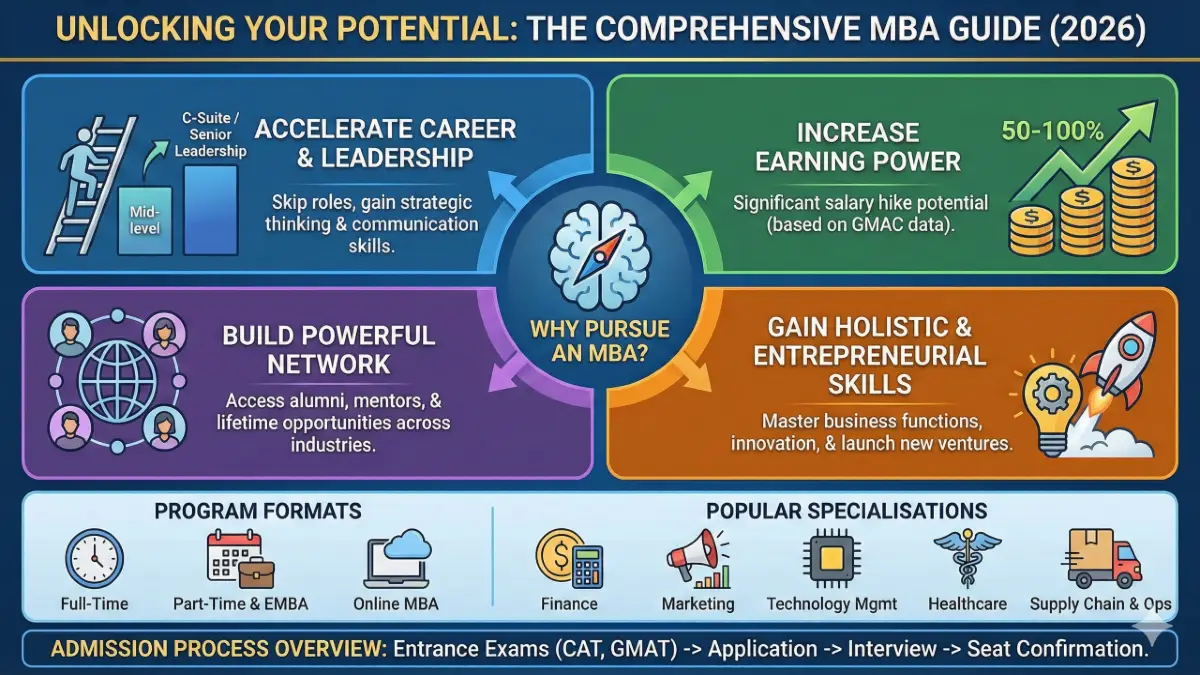
Accelerate Your Career and Leadership Potential
Faster tracking of their career is one of the most common reasons why people decide to enrol in an MBA course. An MBA can provide you with a competitive advantage whether you are in the field of technology, finance, healthcare, or even the consulting line of work.
Without an MBA, your career may end up having slow and incremental promotions. But with an MBA, numerous professionals skip over previous roles and jump into mid-to-senior-management roles, such as product manager, financial analyst, or even C-level executive. The MBA programme improves your strategic thinking, communication, and business skills, which are invaluable to employers as leaders.
Increase Your Earning Power
Another strong reason to pursue an MBA program is the financial gain. According to surveys and research conducted by institutions like the Graduate Management Admission Council (GMAC), MBA graduates are likely to get their pay increased by 50–100% after graduation.
The investment is huge, sure, but the Return on Investment (ROI) easily justifies it, particularly if you make the right MBA institution and specialisation choice. Firms are willing to pay a high price for leadership and strategic skills that MBA graduates possess.
Build a Powerful Professional Network
Joining an MBA program not only brings knowledge to you in the academic sense; you join a community that will live with you long after your course graduation. The network you can establish with your fellow students, your professors, your guests, and alumni can provide you with new opportunities.
Many top MBA colleges have a huge and strong alumni network, even spanning across industries and continents. These networks may also result in internships, job recommendations, business co-founders, or eventual lifetime mentors in your profession.
Gain a Holistic Business Perspective
MBA courses are structured to give students a comprehensive understanding of how businesses function. You will study everything from accounting and finance to operations, marketing, and strategy.
This all-rounded approach will assist you in having a better view of the larger perspective and make decisions efficiently, a quality that you need, whether you are a department head or running your own business. You will find out how to work with cross-functional teams, how to gain perspective on business drivers and evaluation of opportunities, and risks.
Cultivate Entrepreneurial Skills
If you have been dreaming of starting your own venture, then the MBA programs can be your launchpad. Business plan competitions, startup incubators, and innovation and entrepreneurship courses will help you get your hands on the tools to evaluate the market demand and create scalable models, and receive sufficient capital.
Some MBA colleges even provide seed capital or venture capital network access. More crucially, they provide you with mentorship and strategic foundations for long-term success.
Types of MBA Program Formats
-
Full-Time MBA: This traditional educational model is usually a two-year (one year in some cases) program. It is engaging and most applicable to individuals in need of a career change or desiring acceleration of their careers. It’s a critical commitment, but the learnings and the network that you will build are huge, so it’s worth it.
-
Part-Time & Executive MBA (EMBA): These formats are made to facilitate the needs of working professionals so that the students can balance work and studies. EMBA programs require extensive managerial experience and are tailored to senior professionals.
-
Online MBA: The MBA program has been made even more accessible with the availability of technology. Online programs are flexible, and most of the time, they follow the same curriculum as on-campus MBA programs. It is the best suited to individuals who require either geographical or time flexibility.
Popular MBA Specialisations
The specialisation is important when making your MBA course selection. The following are some of the popular specialisations:
-
Finance and Accounting: Prepares you for roles in banking, investment, and corporate finance.
-
Marketing: Focuses on brand management, digital marketing, and consumer behaviour.
-
Technology Management: Combines business skills with IT and innovation strategy.
-
Healthcare Management: Ideal for those looking to lead in the health sector.
-
Supply Chain & Operations: Prepares students to optimise production and distribution processes.
Here’s What the MBA Curriculum Will Teach You
The core MBA curriculum usually includes subjects like:
-
Economics
-
Organizational Behavior
-
Financial Accounting
-
Business Strategy
-
Data Analytics
-
Operations Management
-
Business Ethics
Most MBA colleges also offer hands-on experiences through:
-
Case Studies
-
Live Consulting Projects
-
Capstone Courses
-
Industry Internships
This kind of experiential learning is what makes the MBA course different from traditional classroom-based degrees.
How to Choose the Right MBA College
Here are some key factors to keep in mind while selecting the right MBA college.
1. Rankings and Reputation Although global and national rankings can give you an idea about institutions’ brand value, do not rely on them blindly. Find out more about what those rankings are based on, such as the faculty or their placement numbers, and research output.
2. Program Specialization There are MBA institutions specialising in finance, others in entrepreneurship or technology. Choose a school that has a reputation for the MBA course you are interested in.
3. Location and Culture College in a business centre, like Gurgaon (Delhi NCR), will provide increased opportunities for finding an internship and employment. The campus culture also plays a crucial role.
4. Alumni Network A good alumni base can serve as a goldmine for career growth. It may also be important to check whether the school has active participation of the alumni, as well as mentorship schemes.
The Step-by-Step MBA Admission Process Followed in India
Admission to an MBA program often follows an organised admission procedure, starting with the application process and concluding with fee payment for seat confirmation. The MBA admission process usually consists of the following steps:
-
Appearance in an entrance exam such as CAT, MAT, GMAT, or others, as per the college.
-
Submitting your academic transcripts from your previous education.
-
Resume or CV preparation on professional lines with a focus on work and achievements.
-
Preparing an excellent Statement of Purpose (SOP) explaining why you want to pursue an MBA.
-
Inclusion of letters of recommendation, preferably from teachers or professional managers.
-
Selection through a personal interview session is the final evaluation step.
The application preparation should begin early, particularly when you aim to join the leading MBA colleges, as there will be a high level of competition.
Conclusion
The question, “Why MBA?” has no single answer that fits all. For some, it’s about a career change. To others, it is all about climbing the corporate ladder, developing a business, or just gaining a new set of strategic skills. The MBA course has tremendous potential, but only if aligned with what you want to achieve, what is important to you, and what you are willing to commit to. Think about what you actually want in your career and about whether the MBA path is part of the picture or not.
FAQs
Can an MBA help me if I don’t have a business background?
Yes! Many MBA students come from engineering, arts, science, or other non-business fields. The program is designed to build foundational business knowledge from the ground up.
Should I take a break from work to pursue an MBA full-time?
That depends on your situation. Some prefer to go all-in and experience campus life, while others need the financial stability of a job and go for part-time or online options. Weigh your priorities, career goals vs. current commitments.
Will an MBA help me change industries, like moving from tech to finance or from education to marketing?
Yes. One of the most valuable parts of an MBA is that it helps you pivot. With the right electives, projects, and networking, you can break into a new field more smoothly.
How do I choose the right MBA specialisation if I’m unsure about my future plans?
Start with what interests you most and where your skills naturally fit. If you’re undecided, a general MBA or dual specialisation can give you exposure to multiple areas before you narrow it down.
How do I decide between doing an MBA in India vs. abroad?
Consider factors like cost, cultural fit, ROI, global exposure, and your long-term career goals. If you want international opportunities, studying abroad might make more sense. If you plan to work in India long-term, domestic programs can be more aligned.