


Popular
In an era where data is increasingly hailed as the “new oil,” the ability to refine that data into actionable business intelligence has become the most valuable skill set in the global economy. As industries transition from traditional management to AI-augmented decision-making, the MBA in Business Analytics has emerged as the premier choice for professionals looking to future-proof their careers.
This comprehensive guide explores the depth of this specialization, covering every critical facet from the MBA Business Analytics Syllabus to the evolving scope of MBA in business analytics in the age of Generative AI.
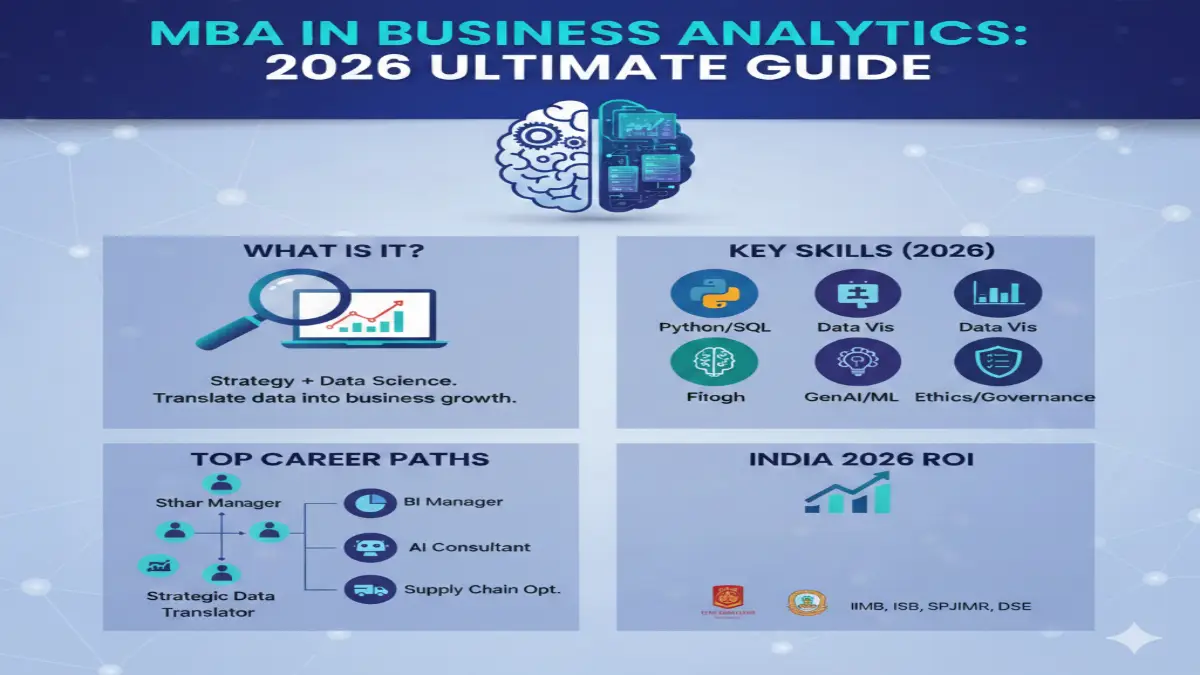
Before diving into the technicalities, it is essential to define what is MBA business analytics. At its core, it is a multidisciplinary postgraduate degree that bridges the gap between pure data science and strategic business management.
Unlike a Master’s in Data Science, which focuses heavily on the technical architecture of algorithms, an MBA in Business Analytics focuses on the application of data. It teaches students how to use statistical tools, machine learning, and quantitative methods to solve complex organizational problems. By 2026, this role has evolved into that of a “Strategic Data Translator”—a leader who can sit in a boardroom and explain how a predictive model will increase the company’s bottom line.
Graduating from this program isn’t just about earning a degree; it’s about acquiring a specialized toolkit. Top colleges design their curriculum to ensure the following outcomes:
Data-Driven Leadership: The ability to lead teams using evidence-based insights rather than intuition.
Technical Proficiency: Mastery over industry-standard tools like Python, R, Tableau, and SQL.
Strategic Optimization: Learning to optimize supply chains, marketing spends, and financial portfolios using big data.
AI Integration: Understanding how to implement and manage AI-driven workflows within a traditional corporate structure.
Why should an aspirant choose this over a General MBA?
High Demand: According to recent industry reports, 91% of companies identify data analytics as a critical driver for business innovation.
Salary Premium: Graduates often command a 30-40% higher starting salary compared to their counterparts in general management.
Global Versatility: The scope of MBA in business analytics is not restricted to tech. From healthcare in Europe to FinTech in India, the skills are universally transferable.
Entrepreneurial Edge: For those looking to start their own ventures, analytics provides the precision needed to find market gaps and scale efficiently.
The MBA business analytics syllabus is typically structured over four semesters. While the first year often covers “Core MBA” subjects (Marketing, Finance, HR), the second year is a deep dive into technical specializations.
To rank as a top-tier professional, you must master these subjects in MBA business analytics:
Business Statistics & Probability: The foundation of all analytical models.
Data Mining and Warehousing: Learning how to store and retrieve massive datasets.
Predictive Analytics: Using historical data to forecast future trends.
Big Data Analytics: Handling unstructured data from social media and IoT devices.
Optimization for Business: Mathematical modeling to find the best solutions under constraints.
Machine Learning for Managers: Understanding neural networks and deep learning from a business perspective.
Most colleges allow students to niche down in their final year:
Marketing Analytics: Focusing on customer lifetime value (CLV) and churn prediction.
Financial Analytics: Focusing on algorithmic trading and risk management.
Supply Chain Analytics: Focusing on inventory optimization and logistics.
HR Analytics: Focusing on talent acquisition and employee retention models.
To secure admission, candidates must meet specific benchmarks. While these vary by institute, the standard Eligibility includes:
Undergraduate Degree: A minimum of 50% aggregate marks in any discipline from a recognized university.
Background: While open to all, students with a background in Engineering, Mathematics, or Commerce often find the technical subjects in MBA business analytics easier to navigate.
Entrance Exams: Valid scores in exams like CAT, GMAT, GRE, XAT, or NMAT.
Work Experience: While not always mandatory, 12–36 months of experience in a technical or managerial role is highly valued by top-tier MBA in business analytics colleges in India.
The Fees for an MBA in Business Analytics can range significantly based on the reputation and location of the institute.
Premium B-Schools (IIMs, ISB): ₹20 Lakhs to ₹38 Lakhs.
Top Private Universities: ₹12 Lakhs to ₹18 Lakhs.
Government/State Universities: ₹2 Lakhs to ₹8 Lakhs.
Scholarship Opportunities: Many institutions offer merit-based scholarships for high entrance exam scorers and need-based financial aid. Corporate sponsorships are also common for working professionals pursuing Executive MBA paths.
The journey to a top school follows a rigorous four-step process:
The Application: Submitting academic transcripts and a compelling Statement of Purpose (SOP).
The Entrance Test: Scoring in the 95th+ percentile for top colleges.
The Shortlist: Based on exam scores and profile strength.
The Final Hurdle: Group Discussions (GD) and Personal Interviews (PI) designed to test analytical thinking and communication.
The Fees for this program vary based on the institution’s tier and placement history. Below is a comparison of the top MBA in business analytics colleges in India:
| College Name | Primary Entrance | Approx. Total Fees | Avg. Salary (LPA) |
| IIM Bangalore | CAT | ₹24.5 Lakhs | ₹34.5 LPA |
| IIM Calcutta | PGDBA Test | ₹25.0 Lakhs | ₹32.0 LPA |
| ISB Hyderabad | GMAT/GRE | ₹38.0 Lakhs | ₹34.0 LPA |
| SPJIMR Mumbai | CAT/GMAT | ₹22.0 Lakhs | ₹30.5 LPA |
| NMIMS Mumbai | NMAT | ₹24.0 Lakhs | ₹23.0 LPA |
| BITS Pilani | BAAT/CAT | ₹12.0 Lakhs | ₹18.0 LPA |
The career opportunities are diverse and span across various high-growth sectors.
Business Intelligence (BI) Manager: Designing systems that help executives see the “big picture.”
Data Scientist (Strategic): Using coding and math to build predictive engines for business growth.
Operations Manager: Using analytics to streamline manufacturing and delivery.
AI Consultant: Advising firms on how to adopt automated intelligence.
Top global firms recruiting MBA Business Analytics graduates in India include:
Consulting: McKinsey, BCG, Deloitte, KPMG.
Tech: Google, Amazon, Microsoft, Meta.
IT Services: TCS, Infosys, Accenture, Wipro.
Banking: Goldman Sachs, JP Morgan, HDFC.
The rise of data is not a trend; it is a permanent shift in how the world operates. An MBA in Business Analytics is the ultimate bridge for those who want to lead this transformation. Whether you are aiming for a high-paying role in a Fortune 500 company or looking to disrupt the market with your own startup, the insights gained from this degree are invaluable.
The MBA in business analytics scope is immense. As India becomes a global data hub, experts who can manage both “data” and “people” are in short supply. This degree prepares you for leadership roles in any sector that uses digital technology.
Graduates from top-tier colleges typically start at ₹18–25 LPA. For mid-tier colleges, the range is usually ₹8–15 LPA. Senior professionals with 5+ years of experience often cross the ₹40 LPA mark.
While it is quantitative, it is not “difficult” if you have a logical mindset. Most colleges provide bridge courses to help students from Arts or Commerce backgrounds get up to speed with coding and statistics.
Yes. The admission process does not usually require prior coding knowledge. You will learn the necessary technical skills—such as Python and SQL—as part of the curriculum.
The CAT is the gold standard for India. However, the GMAT is excellent for international programs or the ISB. NMAT and SNAP are also great options for private universities like NMIMS and Symbiosis.